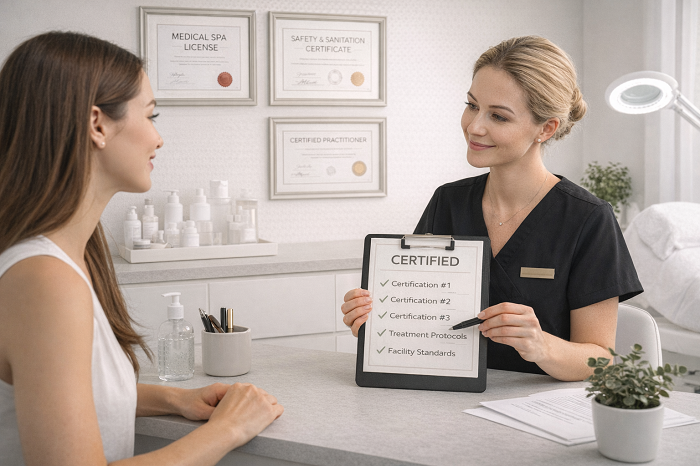
Understanding medical spa regulations and certifications is essential for anyone seeking safe, effective, and personalized skincare treatments. The industry’s standards are evolving quickly, making it crucial for clients and clinic owners to stay informed, verify credentials, and demand transparency. Here are the essential insights you need for confident, compliant choices:
- Demand visible facility licenses—Insist on clear proof of clinic licensure, safety protocols, and a named medical director to ensure you receive regulated, client-focused care.
- Verify all provider credentials—Always ask for practitioner licenses and recent certifications; a board-certified medical director or equivalent oversight is your best safety guarantee.
- Expect transparent advertising—Look for spas that show real, unedited before/after photos and provide honest details about treatments, risks, and practitioner qualifications before you book.
- Check compliance on privacy and safety—Reputable spas use secure record-keeping, documented consent, and strict infection control, giving you peace of mind for both results and confidentiality.
- Know your region’s rules—Medical spa ownership, provider roles, and treatment permissions vary by province and state; always confirm your spa’s compliance on official health board sites.
- Insist on ongoing staff education—Choose clinics where continuing education and latest device training (16–50+ hours annually) are proudly displayed to assure quality and innovation.
- Leverage consumer protections—You have the right to file complaints, access credentials, and receive full aftercare support—a respected spa welcomes your questions and feedback.
Choose medspas that combine visible expertise with transparent, personalized care—and dive deeper into the full article for actionable checklists, regional comparisons, and safety must-knows before your next treatment.
Introduction
What if you discovered that the difference between a serene, confidence-boosting medical spa visit and a risky, unregulated treatment often comes down to who owns and supervises the clinic—and how transparently they share their credentials?
That’s not just industry talk—it’s your peace of mind on the line. With nearly one in three adults now seeking advanced skincare or non-surgical cosmetic solutions, demand is at an all-time high. This growing interest comes with a sharper focus on safety, visible results, and full transparency, reshaping the way medical spas across Ontario and beyond are regulated.
But here’s a truth not everyone knows:
Not all spas are created equal.
- Some are owned and run only by board-certified physicians; others allow non-physician owners if there’s a licensed medical director in charge
- Regulations shift between provinces and states, making it essential to know what’s required wherever you book
- The introduction of high-tech devices—think Morpheus 8 and smart lasers—means training, safety, and ongoing certification are under the microscope like never before
If you’ve ever felt uncertain about who’s performing your treatment, how products are sourced, or what aftercare actually entails, you’re not alone. Clients now demand more: open conversations about risks, clear before/after results, and easy ways to verify staff training. In the new landscape, regulation isn’t just about compliance—it’s a promise of integrity and excellence at every step.
This guide gives you the clarity you deserve: you’ll uncover
- how facility licensing and medical oversight protects you
- what certifications matter most for injectors and laser pros
- why transparent advertising and privacy standards are non-negotiable
- and how evolving laws shape your choices, from Mississauga to Miami
Understanding these rules means making empowered decisions—whether you’re booking your first treatment or evaluating a spa’s credentials. You deserve to trust every step of your journey.
Ready to see how regulations are keeping pace with innovation—and shaping tomorrow’s safer, more personalized aesthetic care? Let’s begin with the shifting landscape driving change throughout the medical spa industry.
The Evolving Regulatory Landscape of Medical Spas
Why Medical Spa Regulations Are Changing Fast
The world of medical spas is evolving rapidly, especially as we step into 2025.
A surge in demand for safe, non-surgical aesthetic procedures has triggered regulators across North America to revisit old rules and craft new standards.
Picture this: 1 in 3 adults now seeks out advanced skincare or injectables, and clients are demanding visible, personalized results with maximum transparency.
This push from clients—coupled with rapid advances in technology—means regulations can change seemingly overnight.
How Medical Spas Differ From Day Spas and Clinics
Understanding what sets a medical spa apart from a traditional day spa or cosmetic clinic is crucial for both clients and owners.
- Medical spas offer procedures like injectables, lasers, and medical-grade peels, which legally count as medical acts
- Day spas focus on relaxation and basic skincare, without medical oversight or prescription products
- Cosmetic clinics often include surgery or advanced dermatology procedures, strictly overseen by physicians
If you ever wondered why some spas can offer Botox while others cannot, it’s because of the way medical procedures are classified and licensed.
Who Can Own and Operate Medical Spas?
Ownership rules are a hot topic—and they shape everything from quality standards to who is responsible if something goes wrong.
- In many regions (e.g., Ontario, California, New York), only licensed physicians can own a medical spa
- Some states and provinces, like Arizona or Florida, allow non-physician ownership if an MD acts as a medical director
- This trend raises vital questions: Who is accountable for safety? How closely are treatments supervised?
A key insight: “When non-physicians own med spas, strong oversight from a board-certified medical director is the client’s safety net.”
Who Pushes for Better Standards—and Why It Matters
Medical associations (like ASDSA) and industry coalitions are shaping tomorrow’s standards through model acts and advocacy.
- They propose templates for training, supervision, and facility protocols
- Their goal: Consistent protections for clients, regardless of who owns the spa
As new devices like Morpheus 8 and smart lasers hit the market, regulators and associations are rallying for up-to-date training and public disclosure—because clients want to see authentic before/after results, not just promises.
Transparency, Safety, and What Clients Should Expect
Today’s clients crave open communication, clear credentialing, and honest advertising.
Modern regulations now emphasize:
- Practitioner training and detailed disclosure of risks/outcomes
- Facility safety, infection control, and ongoing inspection
- Easy ways to verify spa legitimacy and register complaints
More than ever, being informed is being safe: “Ask to see credentials, protocol details, and genuine client results—your peace of mind is non-negotiable.”
For anyone choosing or running a medical spa, the big message is this: Regulatory expectations are rising fast, shaped by real client needs and new technology. Be proactive—insist on visible standards, clear communication, and a team that holds your trust at every step.
Core Regulatory Requirements for Medical Spas
Facility Licensing and Location Standards
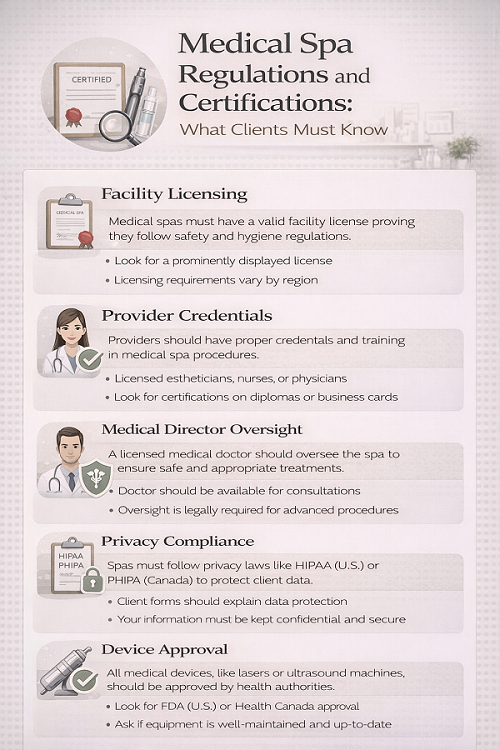
Every medical spa must have a valid facility license issued at the provincial or state level.
Local standards often dictate details like infection control protocols, proper ventilation, and assuring private, serene treatment rooms. Picture walking into a spa where every surface shines—this peace of mind is no accident; it’s demanded by law.
Regular facility inspections are typical for:
- Laser and IPL devices (must be registered and periodically certified for safety)
- Injectable product storage (secure, regulated, and meticulously tracked)
- Emergency readiness plans (clear, documented protocols for staff)
Record-keeping is non-negotiable, with logs kept for every client visit, treatment, and product used.
Quotable:
“A certified medical spa looks just as safe behind-the-scenes as it feels at the front desk.”
—
Ownership and Medical Oversight
Ownership rules depend on location. In Ontario and most U.S. states, licensed physicians must own or directly oversee the spa, while places like Arizona or Florida allow non-physician ownership, provided there’s a medical director on staff.
A medical director should be:
- Board-certified (preferably in dermatology or plastic surgery)
- Present on-site, or available for emergencies and staff guidance
- Responsible for approving all treatment protocols, conducting safety audits, and overseeing ongoing staff education
Supervision standards can range from direct, hands-on involvement to remote, “on-call” oversight—always check local laws.
Quotable:
“Your safety depends on who’s signing off on every protocol—don’t hesitate to ask for credentials.”
—
Advertising, Transparency, and Client Protections
Transparency isn’t optional. Laws require all advertising and client communication to be:
- Accurate about treatments, risks, and provider qualifications
- Supported by before/after visuals that reflect real, unedited results
- Clear on expected outcomes, side effects, and contraindications
Clients have the right to:
- Access practitioner credentials and training information
- Receive clear consent forms and personalized aftercare instructions
- File complaints with regional health authorities and consumer protection agencies
Quotable:
“A legitimate medical spa treats every question and concern as a sign of your commitment to self-care.”
—
The essential takeaway: Look for medical spas with visible facility licenses, transparent advertising, and a named, board-certified medical director. These details signal a true commitment to your safety, confidence, and real results—because when it comes to your skin, regulation is a promise, not just paperwork.
Professional Licensing and Staff Certification
Core Clinical Roles: Legal Requirements & Scope of Practice
Choosing a medical spa means trusting a team whose training and scope of practice are precisely regulated. Every core clinical role has specific licensing and certification requirements—and these can vary by jurisdiction.
Picture this: A seamless, relaxing visit where you know exactly who is treating you, and what their qualifications are. Here’s how roles typically break down:
- Physicians (MD/DO):
- Valid state/provincial medical license
- Approved to perform medical/aesthetic procedures
- Legally responsible for clinical oversight
- Nurse Practitioners (NPs) & Physician Assistants (PAs):
- State license and prescriptive authority
- Delegated rights for injectables and lasers
- Must operate under, or in consultation with, a licensed physician/medical director
- Registered Nurses (RNs) & Licensed Practical Nurses (LPNs):
- NCLEX-RN or provincial license
- Procedure-specific certifications (e.g., Botox, lasers)
- Permitted tasks are jurisdiction-dependent
- Laser Technicians & Aestheticians:
- Accredited training completion (often 16–32 hours CE)
- Ongoing continuing education
- Additional registration for laser/IPL in some provinces/states
- Medical Assistants:
- Certified (CCMA/CMA), 80+ supervised clinical hours
- Cannot perform invasive treatments
- Always supervised by licensed professionals
Training, Continuing Education, and Safety Protocols
In 2025, up-to-date procedural training is non-negotiable for all practitioner types. Regulations now require:
- Ongoing education—many states mandate at least 16 annual CE hours for estheticians and up to 50 for physicians involved in aesthetics.
- Manufacturer/device training for new technologies like Morpheus 8 or biostimulatory injectables.
- Demonstrable knowledge of site-wide infection control, emergency response, and adverse event reporting protocols.
Visualize staff calmly responding to any scenario—swiftly managing rare complications, keeping your wellbeing at the centre.
Ensuring Personalization, Safety, and Confidence
A certified team isn’t just a nice-to-have—it’s the core of spa safety. When you check your provider’s license or ask about their latest training, you’re taking an empowered step.
Three fast takeaways for clients:
- Always verify staff credentials and ask about specialized certifications.
- Look for displayed proof of continuing education in the lobby or consultation room.
- Ask about training on the latest devices—“How recently were you certified on this treatment?”
A certified, well-trained team is your best guarantee of safety and beautiful, real results. Informed clients and transparent providers build trust—one credential at a time.
Compliance Standards: Privacy, Safety, and Legal Best Practices
HIPAA (or Provincial Equivalent) for Patient Data Protection
Medical spas must safeguard client information with strict confidentiality protocols.
Digital health records, photos, and consent forms must be encrypted and securely stored, meeting HIPAA in the U.S. or PHIPA in Ontario.
Staff training is non-negotiable: mandatory privacy education ensures everyone—from receptionist to physician—is fluent in patient rights and data handling.
Clients can request, update, or restrict access to their records at any time.
“Picture this: Your before/after gallery is only accessed by authorized clinicians, never shared without written consent.”
OSHA and Workplace Safety
Safety is central to client trust.
Every treatment room must meet OSHA or provincial safety codes, including:
- Proper storage and handling of sharps
- Bloodborne pathogen protocols
- Regular sanitation using up-to-date, approved disinfectants
- Accessible, fully stocked PPE (personal protective equipment)
Detailed emergency procedures—such as for allergic reactions or needlestick injuries—must be documented, visibly posted, and practiced.
All staff log their safety trainings, keeping records updated for inspections.
“A calm, spotless spa is not just serene—it’s evidence of world-class compliance in action.”
Controlled Substances, Product Registration, and FDA/Health Canada Compliance
Using prescription injectables (like Botox or fillers)?
- Hold active DEA (US) or Health Canada (Canada) registration for controlled substances
- Store all pharmaceuticals in secure, temperature-regulated, logged cabinets
- Use only FDA or Health Canada-cleared technology and products
Every dose and device batch must be tracked from supplier to client record, supporting safety and recall readiness.
“Nothing enters your skin that isn’t rigorously registered, tested, and approved.”
Accurate Documentation and Reporting
Every detail matters—from initial consent to any “red flag” during aftercare.
Requirements include:
- Recording every treatment, batch number, and staff involved
- Detailed consent forms listing all possible risks and alternatives
- Swift reporting of any injuries, complications, or client complaints to regulatory agencies
Clear, accurate records protect both clients and clinics—providing peace of mind with every visit.
At reputable medical spas, compliance isn’t just paperwork—it’s a daily, visible standard of care. When you step into a licensed clinic, you’re guaranteed privacy, safety, and a transparent path from consultation to results.
Navigating State and Provincial Variations: Comparative Overview
Key Differences by Jurisdiction
When it comes to medical spa regulations, geography matters—sometimes more than you think.
Picture this: The same treatment, like a laser session, might be supervised by a board-certified physician in New York, but performed under a nurse’s direction in Arizona or Florida.
Compare these standout variations:
- Ontario (Canada): Only physicians or nurse practitioners can legally prescribe injectables. Every provider must maintain provincial licensure, and spas must uphold strict infection control protocols.
- California & New York: Only physicians can own or operate medical spas. Pre-procedure exams by an MD are mandatory, and there are tough rules on advertising—no overstated claims or misleading “medical” labels.
- Florida: Medical spa ownership is open to non-physicians, but a licensed medical director must oversee all services. RNs can’t perform injections or operate lasers without written orders and direct protocols.
- Texas: Only physicians can own med spas offering lasers or injectables, though corporate structures allow limited exceptions. Every laser session must be done under an MD or their written authorization.
- Arizona: Allows non-physicians to own spas, provided there’s a medical director and staff hold specific licenses. All laser/IPL devices require state registration, and regular facility inspections are common.
Visualize walking into a spa—depending on where you are, you’ll find different signage, staff credentials, and even consent forms shaped by local law.
Staying Current with Regulatory Changes
With regulations evolving rapidly—often yearly—being out of date isn’t just risky, it’s unsafe.
Every medical spa owner or client should:
- Verify rules: Always check the licensing status of providers and facility credentials on official state/provincial medical or nursing board websites.
- Consult legal experts: Laws can change overnight; routine check-ins with regulatory counsel keep practices compliant.
- Join industry associations: Groups like the American Society for Dermatologic Surgery Association (ASDSA) or Canadian Aesthetic Medicine Association offer updates, advocacy, and vital compliance education.
A memorable saying for spa operators: “If you’re not reading the latest rulebook, you’re playing with last year’s penalties.”
Visual checklists, staff license displays, and up-to-date certifications—all signal a spa’s commitment to standards and safety in a changing legal landscape.
Ultimately, knowing the key differences between regions and staying alert to yearly shifts is the surest way to protect both your practice and your skin.
Trends Shaping Medical Spa Regulation and Consumer Safety
Push Toward National and Regional Standardization
Uniform safety standards for medical spas are quickly becoming a top priority across North America.
Advocacy groups—like the ASDSA—are calling for national-level laws that clarify who can own, operate, and perform procedures in medspas.
- Model acts such as the Medical Spa Safety Act are influencing state and provincial boards
- Some regions, including California and New York, now require physician ownership and pre-treatment medical exams
- States like Arizona and Florida permit non-physician ownership with a qualified medical director, adding complexity
Picture this: One spa in Ontario must follow different licensure and advertising rules compared to a spa in Miami—potentially leading to confusion for both clients and practitioners.
Still, the trend is unmistakable: Standardization is coming, but unevenly—and medspas must stay diligent to remain compliant.
“Consistency and transparency in medspa regulation protect everyone—clients, providers, and the reputation of the industry.”
—
Advances in Treatment Technology and Impact on Regulations
Every year, innovations like Morpheus 8, CoolPeel, and biostimulatory injectables open new doors—and new regulatory questions.
When a device like Morpheus 8 (radiofrequency microneedling) enters the spa, it often triggers:
- Updated staff training requirements for safe and effective use
- New certification mandates for lasers or injectables (16-32+ CE hours per role in some states)
- Ongoing device registration and inspection by health boards
For example, Arizona now mandates laser equipment registration and staff certification; other regions set annual review protocols.
Expect regulations to keep pace with tech, especially as new treatments sharpen the line between spa and medical clinic.
“Technological leaps demand that medspas adapt fast—regulations are not standing still.”
—
Consumer Awareness, Transparency, and Quality Assurance
Clients today want more than glossy promises—they expect clear, visible results and absolute transparency.
This demand shapes regulation in several direct ways:
- Advertising laws now require spas to reveal practitioner qualifications and potential risks upfront
- Most regions demand easily accessible before/after galleries and authentic ingredient lists
- Consumer protection agencies (like Health Canada, state medical boards) offer public databases so you can verify a spa’s legitimacy before booking
Imagine scrolling a spa’s Instagram and instantly finding proof of certifications and authentic client results—this is the new normal.
“A confident client is an informed client—transparency isn’t a trend; it’s a standard.”
—
Today’s safest, most reputable medical spas don’t just meet the rules—they set the pace for personalized care, visible results, and open communication. For clients, this means demanding proof before you book; for providers, it means a commitment to lifelong learning and compliance.
In Canada, all aesthetic devices and injectables must comply with Health Canada medical device regulations to ensure client safety and product integrity.
Conclusion
Clear, trustworthy standards are the backbone of every safe, transformative medical spa experience. When you know what to look for—transparent credentials, certified staff, regulated procedures—you put your care and confidence first.
Stepping into a regulated medspa means more than pampering: it’s protection, personalization, and visible results delivered by professionals who are accountable to you—and the law.
—
Here are the most powerful ways you can take charge of your medspa journey:
- Always verify facility licenses and provider credentials before booking any treatment
- Ask for clear before/after results and transparent disclosure of risks, not just glossy promises
- Check that your provider’s training and certifications are up-to-date—especially for new technologies
- Look for documentation: posted medical director info, safety protocols, and consent forms in plain view
- Know your rights to privacy, clear consent, and the ability to report concerns to health authorities
—
Ready to elevate your experience?
Book a personalized consultation—bring your questions, request provider info, and insist on clarity before every procedure.
Stay curious about evolving regulations—follow trusted information sources or join relevant associations to stay empowered.
—
Choosing a compliant, client-centered medical spa is the ultimate act of self-care. Invest in real standards—your results and peace of mind are worth it.
“When it comes to your skin and your safety, regulation is your confidence—revealed.”
Understanding medical spasafety standards helps clients evaluate licensing, provider oversight, and compliance before booking advanced treatments.
If you’re new to aesthetic medicine, start with our definition of a medical spa to understand how medical spas differ from traditional day spas and cosmetic clinics.
FAQs
Q1: What are medical spa regulations and certifications?
Medical spa regulations and certifications are legal and professional standards that govern licensing, provider qualifications, medical oversight, and treatment safety.
Q2: Who regulates medical spas in Canada and the U.S.?
Medical spas are regulated by provincial/state medical boards, Health Canada or the FDA, and professional nursing and physician licensing authorities.
Q3: Do all medical spas need a medical director?
Yes, most regions require a licensed physician or nurse practitioner to act as a medical director overseeing treatments and protocols.