Choosing the right Botox provider and following best practices is essential for achieving natural-looking, safe results. By understanding common injection mistakes and how to avoid them, you can protect your wellbeing, enhance your confidence, and ensure every visit delivers real value.
Empower your best results by embracing transparency, personalized planning, and proactive follow-up—read the full article for deeper guidance on avoiding common Botox mistakes.
What if the smallest misstep in Botox injection technique—or one missed question during your consult—could mean the difference between a refreshed, confident look and weeks of visible regret?
Many clients seeking Botox worry less about the needle than about the outcome. You want smoother skin and peace of mind—but how do you avoid the most common Botox injection mistakes that lead to uneven brows, frozen expressions, or lingering bruises?
At Derma Secret, we know that “just Botox” is never one-size-fits-all. Every face, every goal, and every potential pitfall is unique. That’s why understanding common Botox injection mistakes—and how to prevent them—is the first step toward confident, natural-looking results. Our highest priorities are transparency, personalized planning, and open communication so you never feel like just another face in the waiting room.
Our professional Botox treatment at Derma Secret is built on this philosophy of personalization, transparent communication, and commitment to ongoing education.
But with growing demand in Mississauga and Waterloo, common pitfalls are still on the rise—from unlicensed injectors at parties, to shortcuts in facial mapping, or clients not knowing which medications to disclose. The smallest oversight can leave a visible (and sometimes lasting) mark on your wellbeing and your results.
Here’s what you’ll gain in the following guide:
Think of this as your insider’s map to navigating Botox with confidence—from your first question to stunning, natural results.
Let’s uncover how the right preparation, honest communication, and a truly personalized approach transform not just appearances, but your peace of mind at every step.
Ready to spot—and sidestep—those avoidable missteps? It all begins with understanding what really counts as a Botox mistake, and why even small choices shape your outcome.
Mistakes in Botox injections can happen on both sides of the treatment chair—by the clinician, or through choices the patient makes before and after the procedure.
A “mistake” covers any misstep that affects your results or safety, from imperfect injection technique to skipping honest conversations about health history. Some errors show up as minor cosmetic issues, while a small number can lead to lasting or even serious side effects.
Think beyond just a visible “botched job”—common mistakes include:
On the patient side, mistakes like not listing all medications (especially blood thinners and herbal supplements) or choosing a non-licensed provider are increasingly reported across Ontario.
Errors occur when skill, planning, and communication break down. Most can be traced to:
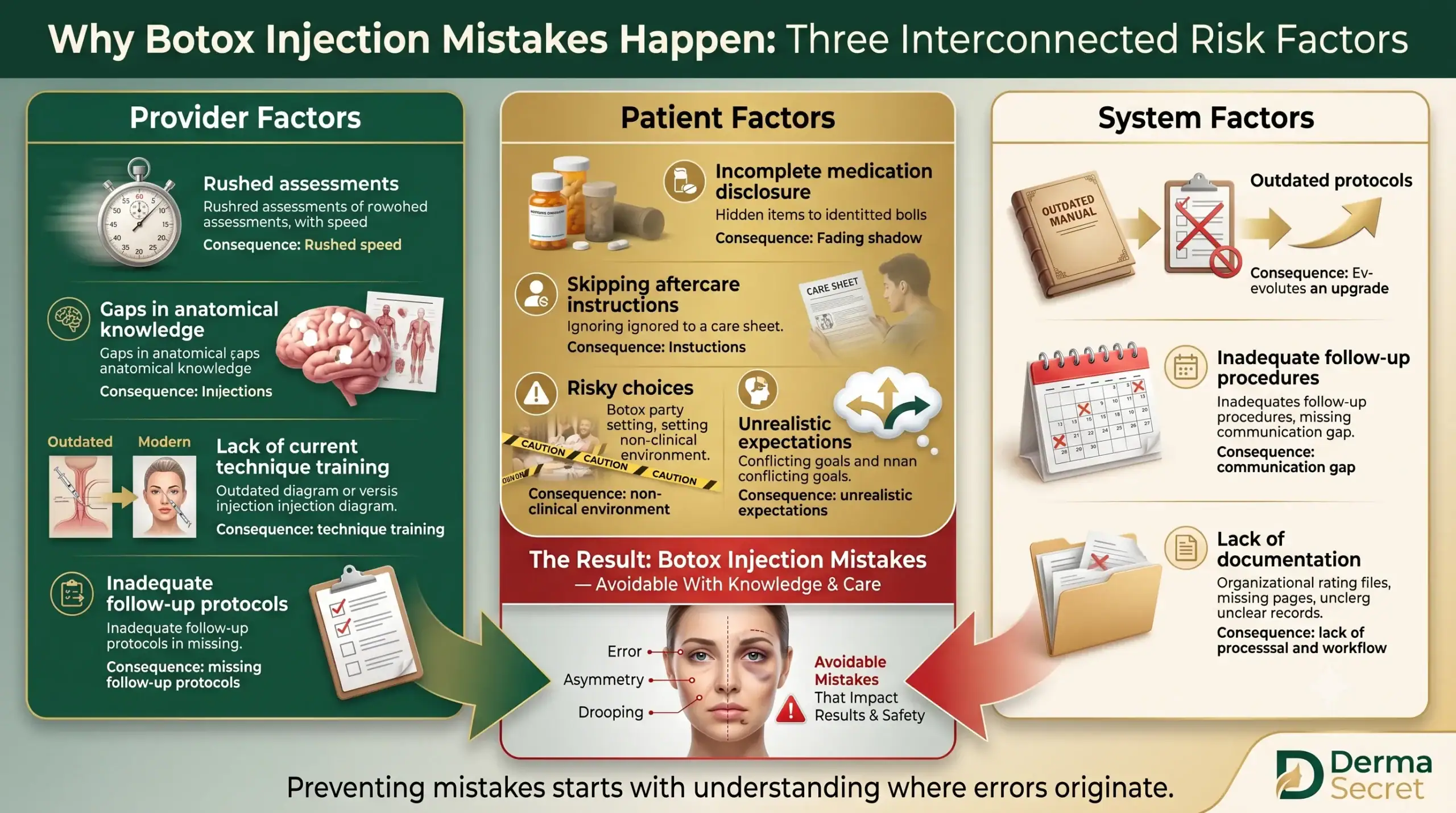
Picture this: a single misplaced forehead injection can cause the dreaded ‘Spock brow’ in under two weeks—an outcome that’s largely preventable through careful anatomical assessment and meticulous mapping.
For most, issues are mild—think slight asymmetry or bruising.
However, rare complications like eyelid droop, unintended muscle weakness, or, in severe cases, systemic reactions demand urgent medical care and highlight the need for transparency at every step.
Client safety and outcome excellence are non-negotiable; integrity and clear communication are as essential as technical skill.
Staying updated with evidence-based protocols and committing to ongoing hands-on training is what separates consistently beautiful results from avoidable problems.
Botox is as much about the how as the what. For your safest, most satisfying outcome, prioritize providers who value transparency, tailored planning, and follow-up as much as technical excellence.
The biggest difference between a “mistake” and a success? It’s not luck—it’s the dedication to personalized care, up-to-date skills, and open communication every single time.
Botox success starts with precise anatomical mapping—and mistakes here can lead to dramatic, visible issues.
Injecting too low in the frontalis or too near the orbital rim is a fast route to brow or eyelid droop (ptosis) and the infamous “Spock brow.”
Common errors include:
Picture this: a single poorly placed injection and suddenly, a client’s symmetrical smile is gone—replaced by unexpected heaviness or uneven eyebrows.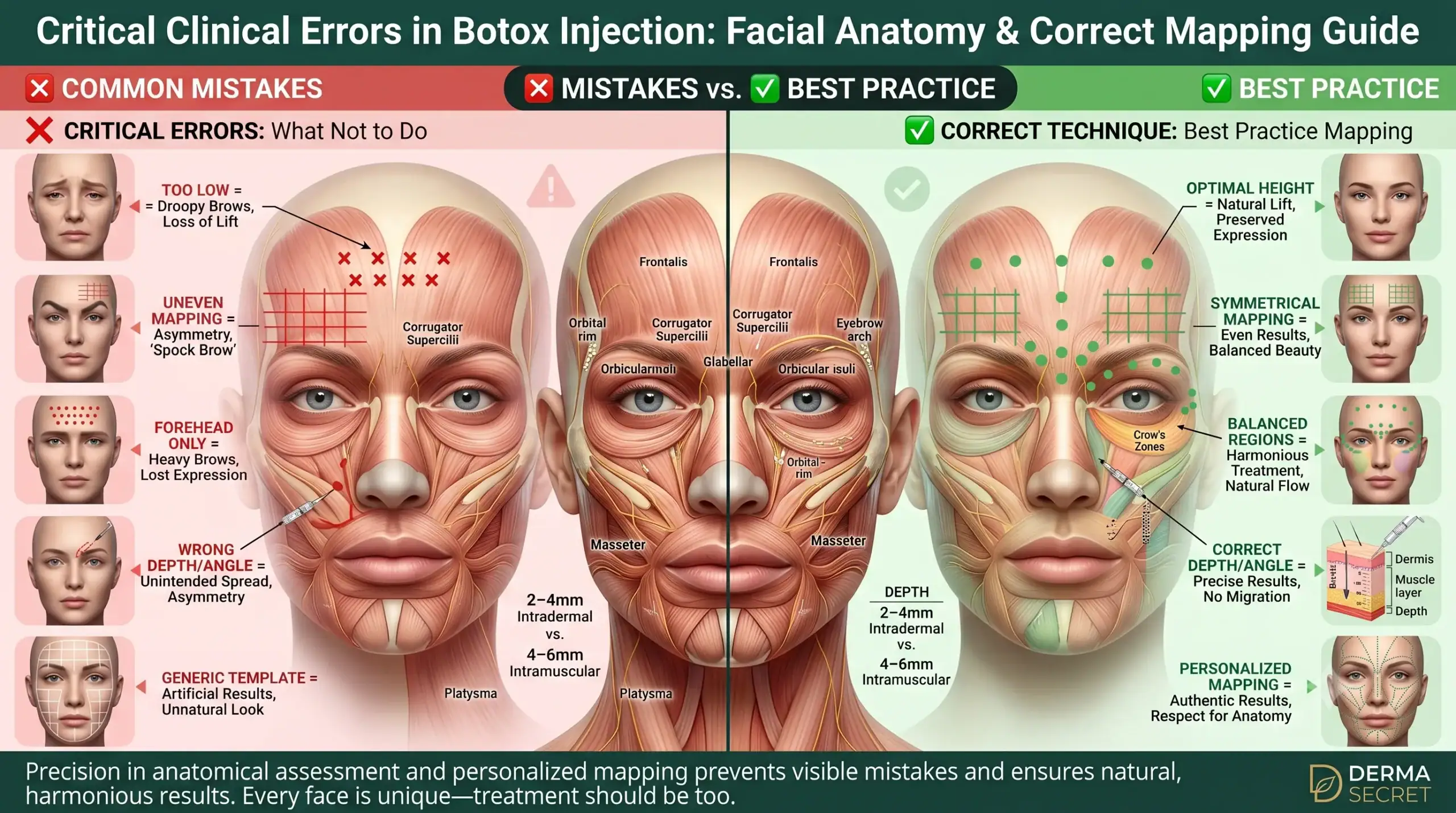
Key prevention: always assess muscle movement pre-procedure, mark true muscle borders, and double-check with high-quality diagrams.
—
Too much Botox produces a frozen, mask-like look; too little leaves clients frustrated by weak results or quick fade. For example, Botox lip injections, also known as a ‘lip flip,’ require precise, conservative dosing to achieve natural enhancement without over-treatment.
Troubles often arise from:
Protocols for safer delivery:
A small adjustment at the next visit can be the difference between a natural glow and a rigid appearance.
Understanding where to inject is just as critical as how much to inject. Our comprehensive Botox injection sites and techniques guide walks through facial anatomy mapping, safe injection zones, and specialized techniques—ensuring every placement is precise, personalized, and predictable.
—
Using templated injection grids ignores unique facial symmetry, skin texture, and dynamic lines.
Pitfalls include:
Practice tip: use pre-treatment photos and digital mapping—to capture subtle asymmetries and tailor every treatment.
“Customized Botox—tailored to your unique anatomy and goals—ensures that every treatment respects your facial structure and personal expression.”
—
Ignoring a patient’s history amplifies risk. Blood thinner use is a well-known contributor to bruising; undiagnosed neuromuscular disorders can lead to unpredictable toxin behavior. That’s why disclosure matters.
Health Canada’s guidance on cosmetic injections emphasizes that anyone considering an injectable cosmetic procedure should consult a medical professional with experience in such procedures and disclose all health conditions and medications.
Key prevention:
—
The difference between intradermal and intramuscular technique is not just academic—it’s essential for real-world results.
Potential oversights:
Hands-on mentorship and precise anatomical study are non-negotiable; advanced cases should always be supervised.
—
Focusing only on the forehead, for example, with high doses can flatten the brow and cause heaviness.
What to avoid:
Always plan harmonious treatments for multi-area balance and target at-risk groups with extra caution.
—
Unclear goals lead to dissatisfaction, even with flawless technique.
Best practices:
“Outstanding Botox outcomes rest on three pillars: technical skill, transparent communication, and authentic follow-up care.”
—
A two-week review is critical for spotting and correcting subtle asymmetries.
Essentials include:
Consistent follow-up isn’t just an extra—it’s part of excellent care.
—
The most impactful Botox outcomes depend on anatomical mastery, personalized planning, and authentic client communication—precision, care, and follow-up are your best prevention.
Not all injectors are created equal—your safety and results depend on it.
Selecting a provider at a “Botox party,” accepting deep-discount offers, or choosing a home visit increases your risk for complications and unsatisfactory outcomes.
Red flags for poor practice include:
To protect yourself:
The American Society of Plastic Surgeons emphasizes that board-certified plastic surgeons have specialized training and in-depth anatomical knowledge that makes them better equipped to administer injectables safely—especially for complex facial anatomy.
“At Derma Secret, we prioritize your health and peace of mind above all else. That’s not a marketing line—it’s how we practice.”
Skipping vital information during consultation can make or break your results.
Unreported details like blood thinner use, herbal supplements, or recent cosmetic work can increase bruising, slow healing, or reduce Botox’s effect.
Do not omit:
A truly personalized experience starts with radical honesty and open communication.
“One overlooked medication disclosure—like a blood thinner or supplement—can mean unexpected bruising and slower healing. Honesty upfront prevents frustration down the line.”
How you prepare for your appointment directly affects your recovery and results.
Common pitfalls include:
Best practices:
Picture this: You walk in, confident and ready, knowing you’ve optimized every step.
Rubbing, lying flat, or squeezing in a workout right after treatment can undo your injector’s careful work.
The most preventable post-Botox mishaps stem from ignoring simple aftercare tips.
Key steps include:
Pro tip: Set phone alerts as reminders for your first day’s aftercare.
| Timeline | Do ✅ | Don’t ❌ | Why It Matters |
|---|---|---|---|
| PRE-INJECTION (5–7 Days Before) | |||
| Medications & Supplements | Disclose ALL medications, blood thinners (warfarin, aspirin), and supplements (fish oil, vitamin E, ginkgo, turmeric) | Don’t hide or minimize medications; assume “it’s not important” | Increases bruising, swelling, bleeding risk |
| Alcohol & NSAIDs | Stop alcohol and ibuprofen 5–7 days before (with physician approval) | Don’t drink or take NSAIDs close to appointment | Both increase bleeding and bruising significantly |
| Skin Prep | Arrive with clean, makeup-free skin; gentle cleanse morning-of | Don’t wear heavy makeup or apply irritating products the day before | Reduces irritation during numbing and injection |
| Activity Level | Light exercise OK; maintain normal routine | Don’t do strenuous workouts or hot yoga 24 hours before | Increases blood flow, bruising risk |
| Hydration | Drink plenty of water; stay well-hydrated | Don’t arrive dehydrated or hungover | Hydrated skin responds better; reduces bruising |
| POST-INJECTION (First 24–48 Hours) | |||
| Touching the Area | Keep hands off treated areas for 24 hours; avoid rubbing or massaging | Don’t touch, rub, squeeze, or massage injection sites | Prevents product migration to unintended muscles |
| Position & Sleep | Stay upright for 4–6 hours post-injection; sleep on back tonight | Don’t lie flat, sleep on stomach, or rest face on hands | Gravity helps product settle in correct location |
| Exercise & Heat | Wait 24+ hours before strenuous activity; avoid saunas, hot yoga, intense cardio | Don’t do hot workouts, heavy lifting, or vigorous exercise within 24 hours | Heat increases blood flow, swelling, and product spread |
| Makeup & Skincare | Wait 15 minutes before gentle makeup; use gentle cleanser | Don’t apply makeup immediately; avoid harsh scrubs, acids for 48 hours | Reduces infection risk and irritation |
| Alcohol & Blood Thinners | Resume normal diet; avoid blood thinners for 24 hours if possible | Don’t drink alcohol or take NSAIDs for at least 24 hours | Increases bruising and swelling risk |
| Follow-Up | Schedule 2-week follow-up appointment; take before/after photos | Don’t skip the follow-up or assume results are final at day 3 | Fine-tuning at 2 weeks ensures optimal symmetry and satisfaction |
“The hours immediately after injection are critical: your aftercare choices directly influence how quickly you heal and how long your results last.”
Every client decision—from injector choice and medical honesty to preparation and aftercare—plays a starring role in safe, natural-looking results. Prioritizing proven practices isn’t just about beauty; it’s about your lasting confidence and wellbeing.
Spotting problems early means better results—common Botox errors frequently leave visible clues.
Picture this: an overly smooth forehead with “frozen” expression, or an arched outer brow (“Spock brow”) that looks more surprised than serene.
Here’s a rapid-reference table for the most frequent pitfalls and their visible effects:
| Botox Injection Mistake | Resulting Outcome | Prevention Strategy | Severity |
|---|---|---|---|
| Excessive dosing | Mask-like, frozen, expressionless appearance; difficulty with natural facial movement | Start with conservative dosing; titrate at 2-week follow-up; customize units by muscle strength and patient goals | High |
| Poor facial mapping & anatomy errors | “Spock brow,” asymmetry, uneven eyelid height, heaviness in unexpected areas | Assess dynamic muscle movement pre-procedure; mark true muscle borders; use high-quality anatomical diagrams; map individually for each client | High |
| Dilution errors | Weak results, rapid dissipation; or unintended spread to adjacent muscles causing drooping | Use precise, evidence-based dilution protocols; verify concentration before injection; document exact reconstitution method | Medium |
| Forehead-only treatment | Heavy brows, dropped upper eyelids (ptosis), unbalanced facial expression | Always treat glabellar region in balance with frontalis; assess muscle group dynamics before injection | Medium |
| Unapproved toxin source | Severe, unpredictable reactions; inconsistent results; legal liability | Use only FDA/Health Canada-approved products; verify product authenticity; maintain clear product documentation and lot numbers | High |
| Incorrect injection depth, angle, or placement | Asymmetrical results, unintended muscle weakness, product spread to wrong areas | Undergo hands-on mentorship; study precise anatomy; use calipers or digital mapping; supervise advanced cases | High |
| One-size-fits-all approach | Artificial or uneven brow position; results that don’t match unique facial anatomy or client goals | Use before/after photos; create digitally mapped injection points; customize treatment plan for each client’s unique features | Medium |
Most cosmetic Botox side effects are mild and temporary—think minor bruising or fleeting unevenness. However, rare complications (like eyelid droop or systemic symptoms) require fast, skilled intervention. This is why post-treatment follow-up and early symptom recognition are essential.
“Small technique errors can lead to big visual changes—precision is everything.”
Exceptional outcomes start well before the first injection.
For injectors, every session should include:
Patients can protect their results by:
At Derma Secret, every client’s plan is individualized, every result transparently tracked, and each provider undergoes ongoing advanced training.
“Trust blossoms when patients see both luxurious care and rigorous safety standards in action.”
High-resolution before-and-after photography is a powerful tool for both client and provider.
These images reveal subtle changes like brow symmetry, line softening, and overall facial harmony—critical for expectation management and refinement.
All treatments are thoroughly documented:
“A single photo can tell the story of a thousand careful decisions.”
For anyone considering or providing Botox, the essentials are clear: precision, personalization, and open communication safeguard not just your results, but your peace of mind.
Most Botox side effects are mild and temporary—think light bruising or a mild headache.
But a small percentage of cases can involve rare, severe complications that require immediate action.
Be alert for the following red flag symptoms that may appear within hours to several weeks post-injection:
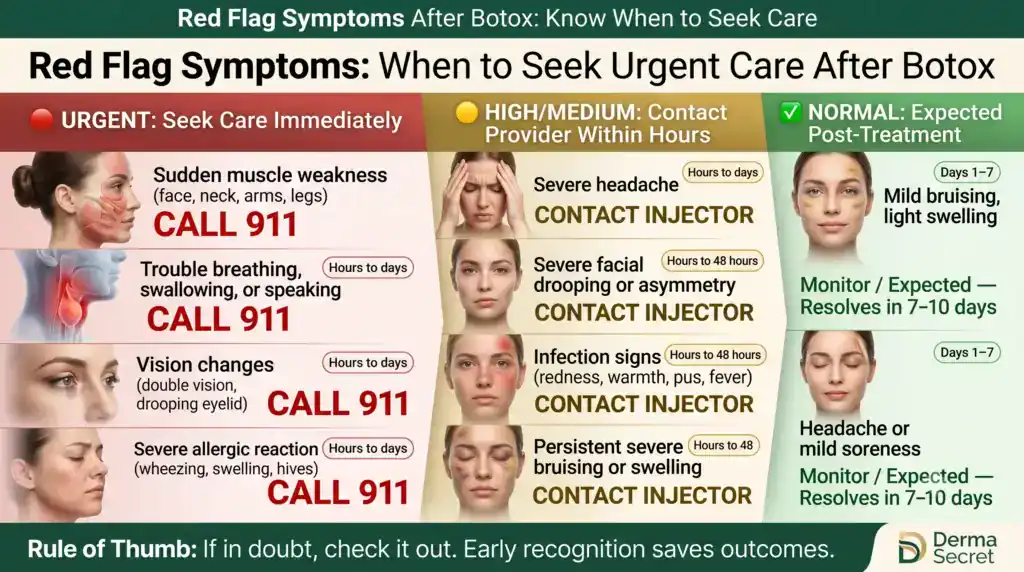
If you experience any of these, seek emergency medical care right away.
A good rule: “If in doubt, check it out.”
When symptoms strike, don’t drive yourself—call 911 or ask for help.
Time is critical, as systemic botox reactions can progress rapidly.
Here’s what to remember:
“Botox emergencies are rare, but they’re real—stay alert, not anxious.”
At Derma Secret, client safety is our highest priority.
If you contact us with concerning symptoms:
We remain available for follow-up, reassurance, or additional care as you recover.
Picture this: A patient texts a photo describing a new drooping eyelid and double vision one week post-injection. Our team connects them to medical care, coordinates the right referral, and fully documents the event to protect both the client and the broader community.
Derma Secret is anchored in transparency and client empowerment. We encourage every patient to:
Our philosophy: “You are never alone on your aesthetic journey—your wellness is our mission.”
The best safety net in Botox care is early recognition of rare complications and fast, coordinated action. Your peace of mind starts with knowing the signs—and knowing we’re always here if you need us.
Every outstanding Botox experience starts with transparent, two-way communication.
Imagine sitting in a serene Derma Secret treatment room, your provider walking you through each step—not just the “how,” but the “why.” You’re encouraged to share personal goals, ask about dosing, and discuss possible side effects or downtime.
Key strategies for genuine empowerment include:
“Truly informed patients are confident patients. Clarity and honest dialogue are our foundation for lasting trust.”
Your care doesn’t end with the injection—expert follow-up is where good outcomes become great.
Picture this: two weeks after your treatment, you return for a comfortable review. Before-and-after images are shared, feedback is heard, and gentle adjustments can be made if needed.
Personalized aftercare means:
“We see every visit as part of a journey—our goal is a look that enhances your natural expression, not a one-time fix.”
For providers, ongoing learning is non-negotiable.
Staying ahead means:
Picture an injector sharing case videos or digital diagrams in team meetings, constantly challenging the team to elevate both results and comfort.
“When education is continuous, excellence is predictable. At Derma Secret, artistry and safety go hand-in-hand.”
The best Botox results are built on open communication, tailored aftercare, and providers who never stop learning. Whether patient or practitioner, these core practices mean every outcome is as unique and confident as you are.
Your best Botox experience is never just a matter of chance—it’s the outcome of smart choices, transparent care, and personalized planning at every stage. When you take an empowered, well-informed approach, you protect not just your beauty, but your confidence and wellbeing for the long term.
True peace of mind comes from knowing what to look for, who to trust, and how to actively partner in your own care. You’re in the driver’s seat—every decision you make shapes your results, safety, and satisfaction.
—
Botox Safety Checklist: Prevent Mistakes Before Your Appointment
—
Your Next Steps: Book Confidently at Derma Secret
—
Every safe, natural, and empowering Botox result starts with knowledge, honest dialogue, and a commitment to excellence—because true beauty is built on trust and care, not just technique.
Your confidence is worth investing in. Choose wisely, communicate openly, and embrace results that honor your unique beauty.